RTG Crane: Complete Guide to Rubber Tyred Gantry Crane for Container Handling
Introduction
An RTG crane (Rubber Tyred Gantry Crane) is a mobile container handling machine designed for stacking, transferring, and loading containers in ports, terminals, and logistics yards. Unlike rail-mounted gantry cranes, RTG cranes use rubber tires instead of fixed rails, allowing flexible movement between container blocks. With multiple power options, precise control systems, and high stacking efficiency, RTG cranes are widely used for modern container yard operations.
What Is an RTG Crane?
An RTG crane is a rubber-tired gantry lifting system mainly used for container handling operations. It is designed to move containers between storage areas, trucks, trailers, and other transportation equipment in container yards.
The full name of RTG is Rubber Tyred Gantry Crane, while Rubber Tired Gantry Crane is another commonly used spelling, especially in North American markets. Both terms refer to the same type of mobile container yard crane.
Unlike traditional gantry cranes that usually operate on fixed rails or foundations, RTG cranes are equipped with rubber tires, allowing them to travel independently within designated yard areas. This mobility makes them suitable for container terminals where flexible yard management and efficient space utilization are required.
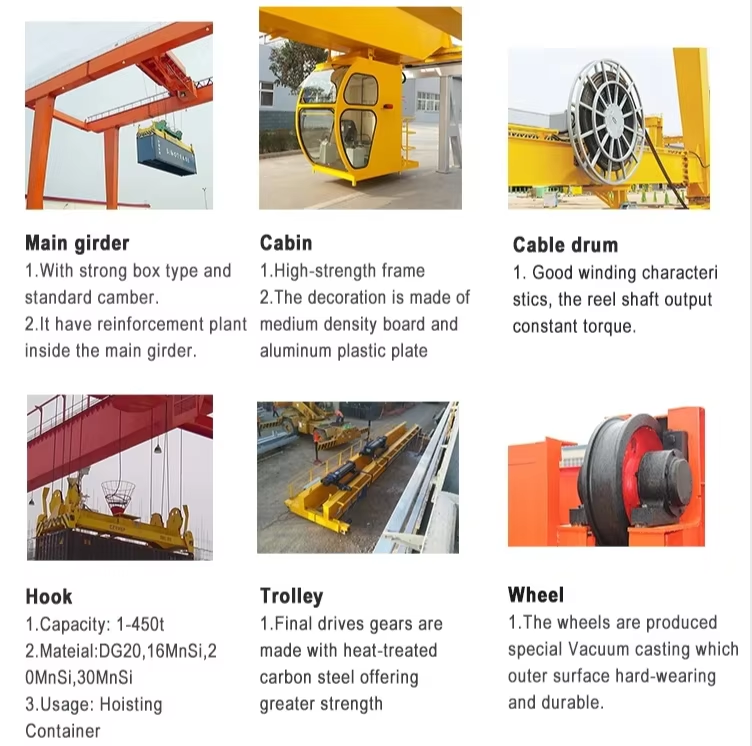
A typical RTG crane consists of:
- Gantry structure
- Hoisting mechanism
- Trolley system
- Travel and steering system
- Power supply system
- Container spreader
During operation, the crane travels along container yard lanes, lifts containers from trucks or storage positions, and places them into assigned stacking locations.
How Does a Rubber Tyred Gantry Crane Work?
A rubber tyred gantry crane operates through coordinated movement of several mechanical and electrical systems. The rubber tire travel system allows the crane to move between container blocks, while the lifting and trolley systems control the vertical and horizontal movement of containers.
The basic operating process includes:
1. Crane Positioning
The RTG crane travels to the target container location through its tire-based travel system. Unlike rail-mounted equipment, it does not require a permanent track system.
2. Container Lifting
The spreader lowers from the trolley system and locks onto the container through twist-lock mechanisms.
3. Hoisting Operation
The hoisting mechanism lifts the container vertically using wire ropes, drums, motors, and braking systems.
4. Horizontal Movement
The trolley moves along the main girder to position the container accurately above the target stacking location.
5. Container Placement
The spreader releases the container after positioning, completing the loading, unloading, or stacking operation.
Modern RTG cranes use PLC control systems and AC variable frequency drives to achieve smooth acceleration, accurate positioning, and reduced mechanical impact during operation.
Main Components of RTG Crane
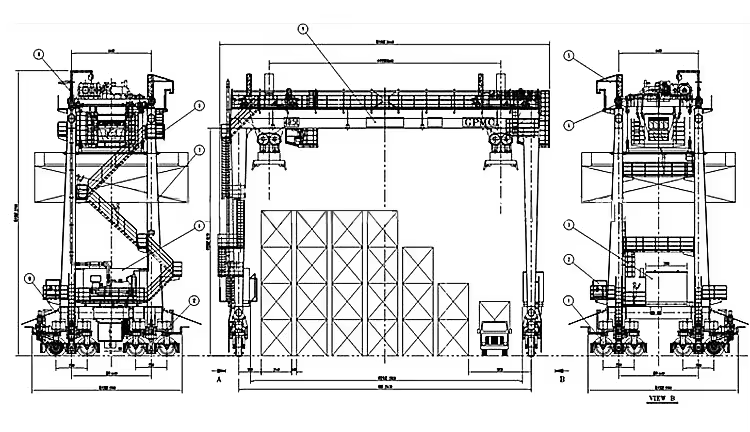
1. Gantry Structure
The gantry structure is the main supporting framework of an RTG crane. It carries the lifting system, trolley mechanism, and container loads during operation.
The main structural components include:
- Main girder
- Supporting legs
- End carriages
The steel structure is designed to withstand repeated heavy-duty operation in demanding environments such as ports and container terminals.
A properly designed gantry structure provides:
- High structural stability
- Long service life
- Reliable operation under heavy loads
2. Hoisting Mechanism
The hoisting system is responsible for lifting and lowering containers.
Main components include:
- Hoisting motor
- Wire rope drum
- Wire ropes
- Brake system
- Container spreader connection system
Through variable frequency control technology, the hoisting system can provide smooth lifting movement and precise container positioning.
For container terminal operations, stable hoisting performance is important because frequent acceleration and stopping directly affect operating efficiency and equipment reliability.
3. Trolley System
The trolley system is installed on the main girder and moves horizontally across the crane span.
Its main function is to:
- Transfer containers between different positions
- Improve positioning accuracy
- Support efficient stacking operations
The trolley movement works together with the hoisting system to achieve accurate container placement in multi-row storage areas.
4. Travel and Steering System
One of the biggest advantages of an RTG container crane is its flexible tire-based travel system.
Unlike RMG cranes that rely on fixed rails, RTG cranes can move through different yard areas using rubber tires.
Depending on the configuration, RTG cranes can achieve multiple steering modes:
- Straight travel
- Diagonal travel
- Crab steering
- 90-degree steering
- Pivot steering
These steering functions allow operators to adjust the crane direction according to yard layout requirements.
This flexibility is especially valuable for container yards where storage layouts may change over time.
5. Power System
RTG cranes can use different power solutions depending on operating requirements, environmental regulations, and terminal infrastructure.
Diesel-Electric System
Traditional RTG cranes commonly use diesel generator sets to provide electrical power for crane operation.
Advantages include:
- High mobility
- Independent operation
- Suitable for large container yards
Cable Reel Power Supply
Electric RTG cranes can use cable reel systems connected to external power sources.
Benefits include:
- Reduced fuel consumption
- Lower emissions
- Suitable for fixed operating routes
Battery Hybrid and Full Electric RTG
Modern container terminals increasingly adopt hybrid and battery-powered RTG solutions.
Advantages include:
- Reduced emissions
- Lower operating costs
- Improved environmental performance
These solutions support the development of greener ports and smart logistics facilities.
6. Container Spreader
The container spreader is the lifting attachment used to handle standard shipping containers.
RTG cranes are typically equipped with spreaders suitable for:
- 20 ft containers
- 40 ft containers
- 45 ft containers
The spreader can include rotation adjustment functions, such as ±5°, helping operators align containers accurately during handling.
Key Features and Advantages of RTG Crane
Flexible Container Yard Operation
The biggest difference between an RTG crane and a rail-mounted gantry crane is mobility.
Because RTG cranes use rubber tires, they do not require permanent rails. This allows operators to adjust crane routes according to changing container yard layouts.
This flexibility makes RTG cranes suitable for:
- Expanding terminals
- Multi-block container yards
- Logistics centers with changing storage requirements
High Container Stacking Efficiency
RTG cranes are designed to maximize container storage capacity by supporting multi-row and multi-level stacking operations.
Typical stacking configurations include:
- 3 containers high over 4 rows
- 5 containers high over 6 rows
The exact stacking capacity depends on:
- Crane design
- Container yard layout
- Customer requirements
Efficient stacking helps terminals increase storage density without expanding yard space.
Multiple Power Options
Modern RTG cranes can be configured with different energy systems:
- Diesel-powered RTG
- Electric RTG
- Hybrid RTG
- Battery-powered RTG
This allows customers to select solutions based on:
- Operating environment
- Energy availability
- Emission requirements
- Total operating cost
Precise PLC Control System
RTG cranes use advanced control technologies, including:
- PLC control systems
- AC variable frequency drives
- Digital control technology
These systems provide:
- Smooth acceleration and braking
- Accurate positioning
- Reduced mechanical stress
- Improved operator control
For high-frequency container handling operations, precise control helps improve productivity and equipment reliability.
Reliable Safety Protection
Safety is a critical consideration for container handling equipment.
RTG cranes can be equipped with:
- Overload protection
- Emergency stop systems
- Safety monitoring systems
- Anti-collision systems (optional)
These safety functions help protect operators, containers, and surrounding equipment during daily operation.
Applications of RTG Crane
An RTG crane is widely used in container handling environments where flexible movement, efficient stacking, and reliable operation are required. Compared with fixed rail-based systems, RTG cranes provide greater adaptability for yards with changing layouts or different operational requirements.
Container Terminals
Container terminals are the most common application area for RTG cranes.
In port terminals, RTG container cranes are used for:
- Container stacking
- Container transfer
- Truck-to-yard operations
- Yard block management
RTG cranes help terminal operators maximize container storage capacity while maintaining efficient loading and unloading processes.
Inland Container Depots
Inland container depots use RTG cranes for container storage and transportation transfer operations.
Typical applications include:
- Container storage management
- Railway container transfer
- Truck loading and unloading
The mobility of RTG cranes makes them suitable for inland logistics facilities where yard layouts may require frequent adjustments.
Logistics Centers
Large logistics parks and freight distribution centers use RTG cranes to improve container and heavy cargo handling efficiency.
Applications include:
- Freight yard operations
- Container organization
- Intermodal transportation support
RTG cranes help reduce manual handling requirements and improve overall yard utilization.
Railway Terminals
Railway container terminals require efficient equipment for transferring containers between trains and road transportation.
RTG cranes can support:
- Container loading from rail wagons
- Container stacking
- Truck interchange operations
Industrial Yards
Some large industrial facilities also use RTG crane technology for heavy material handling.
Potential applications include:
- Steel plants
- Automotive manufacturing facilities
- Heavy equipment manufacturing plants
- Large industrial storage yards
RTG Crane Technical Specifications
The technical specifications of an RTG crane vary depending on lifting capacity, stacking requirements, operating frequency, and customer project conditions.
A typical rubber tyred gantry crane configuration is shown below:
| Parameter |
Specification |
| Crane Type |
Rubber Tyred Gantry Crane |
| Model |
LJ35/40-23 |
| Rated Capacity |
35 t / 40 t |
| Duty Class |
FEM A6-A8 |
| Span |
23.47 m |
| Lifting Height |
12.2-17.8 m |
| Container Type |
20 ft / 40 ft / 45 ft |
| Spreader Rotation |
±5° |
| Hoisting Speed |
13/26 m/min, 23/52 m/min |
| Trolley Travel Speed |
50-70 m/min |
| Long Travel Speed |
Loaded: up to 90 m/min; Empty: up to 130 m/min |
| Maximum Wheel Load |
310 kN |
| Total Rated Power |
110-230 kW |
| Power Supply |
Diesel-electric / Electric / Hybrid / Battery |
Working Conditions of RTG Crane
RTG cranes are designed for outdoor operation in ports, terminals, and logistics yards.
Typical working conditions include:
| Item |
Requirement |
| Ambient Temperature |
-20℃ to +45℃ |
| Relative Humidity |
≤95% |
| Operating Wind Speed |
≤20 m/s |
| Parking Wind Speed |
≤44 m/s |
| Ground Slope During Operation |
≤1% |
| Local Ground Slope |
≤3% |
For special environments, RTG cranes can be customized according to project requirements, including extreme climate conditions, higher operating frequency, or specific power supply systems.
RTG Crane vs RMG Crane
When selecting container handling equipment, many buyers compare RTG cranes with RMG cranes (Rail Mounted Gantry Cranes).
Although both are used for container stacking and transportation, their operating principles are different.
| Item |
RTG Crane |
RMG Crane |
| Full Name |
Rubber Tyred Gantry Crane |
Rail Mounted Gantry Crane |
| Running Method |
Rubber tires |
Fixed rails |
| Mobility |
High flexibility |
Limited to rail routes |
| Infrastructure Requirement |
Lower |
Requires rail foundation |
| Yard Layout Changes |
Easy to adjust |
More difficult |
| Automation Capability |
Available with automation upgrades |
Highly suitable for automated terminals |
| Typical Applications |
Flexible container yards, ports, logistics yards |
Automated container terminals, fixed rail yards |
When to Choose an RTG Crane?
RTG cranes are suitable when customers need:
- Flexible yard operation
- Lower infrastructure investment
- Ability to change storage layouts
- Mobile container handling capability
When to Choose an RMG Crane?
Rail Mounted Gantry Cranes are often preferred for:
- Fully automated container terminals
- Large-scale fixed container yards
- High-volume repetitive operations
RMG systems can integrate closely with automated terminal operating systems and rail transportation networks.
Electric and Automated RTG Crane Solutions
Modern container terminals are increasingly focused on reducing emissions and improving operational efficiency. As a result, electric and automated RTG crane technologies are becoming more common.
Electric RTG Crane
Electric RTG cranes replace traditional diesel generator systems with external electric power solutions.
Advantages include:
- Lower emissions
- Reduced fuel consumption
- Lower operating noise
- Improved environmental performance
Cable reel systems or other electrical connection methods can be selected according to yard conditions.
Hybrid RTG Crane
Hybrid RTG cranes combine traditional power systems with energy storage technology.
Benefits include:
- Reduced diesel consumption
- Better energy efficiency
- Lower operating costs
Hybrid systems are suitable for terminals that require both mobility and improved environmental performance.
Battery Powered RTG Crane
Battery-powered RTG cranes use lithium battery systems to provide clean energy operation.
Potential advantages:
- Zero direct emissions during operation
- Reduced maintenance requirements
- Suitable for green port development
Remote Control and Smart RTG Operation
Modern RTG cranes can be equipped with intelligent technologies, including:
- Remote operation cabins
- Automatic steering assistance
- Container positioning systems
- GPS positioning
- Yard management system integration
These technologies improve operational safety and support the development of smart container terminals.
Automated Container Handling Solutions
It is important to distinguish between RTG cranes and Automated Rail Mounted Gantry Cranes (ARMG).
An ARMG is a type of automated rail-mounted gantry crane that operates on fixed rails. It is commonly used in highly automated container terminals where cranes are integrated with terminal operating systems.
The main differences are:
- RTG cranes use rubber tires and provide flexible movement.
- ARMG cranes operate on fixed rails and are designed for automated yard systems.
However, modern RTG cranes can also be upgraded with automation functions, such as:
- Remote control systems
- Automatic steering assistance
- Container positioning systems
- Smart terminal management interfaces
How to Choose an RTG Crane?
Selecting the correct RTG crane requires consideration of operational requirements, yard conditions, and future development plans.
1. Rated Capacity
The lifting capacity should match the container handling requirements.
Common RTG capacities include:
- 30 tons
- 35 tons
- 40 tons
- Customized capacities for special applications
Buyers should consider:
- Container weight
- Handling frequency
- Future capacity requirements
2. Container Size Requirements
The spreader configuration should match the container types being handled.
Common options include:
- 20 ft containers
- 40 ft containers
- 45 ft containers
3. Yard Layout
The yard design directly affects RTG selection.
Important factors include:
- Container block dimensions
- Travel distance
- Operating lanes
- Ground conditions
RTG cranes are especially suitable for yards requiring flexible operation routes.
4. Working Frequency
The duty class and equipment configuration should match the expected workload.
Factors include:
- Daily operating hours
- Number of container movements
- Peak operation periods
For high-frequency applications, higher-duty configurations may be required.
5. Power Supply Requirements
Customers should evaluate available energy sources:
- Diesel-electric operation
- Cable reel electric power
- Hybrid systems
- Battery systems
The choice affects:
- Operating cost
- Environmental performance
- Maintenance requirements
6. Automation Requirements
For modern smart terminals, buyers should consider optional intelligent systems:
- Remote control
- Automatic positioning
- Anti-collision systems
- Terminal software integration
FAQ About RTG Crane
What is an RTG crane?
An RTG crane (Rubber Tyred Gantry Crane) is a mobile container handling crane that uses rubber tires to move within container yards. It is mainly used for container stacking, transfer, and loading operations in ports, terminals, and logistics facilities.
What is the difference between RTG and RMG cranes?
The main difference is the running system.
RTG cranes use rubber tires, allowing flexible movement between container blocks. RMG cranes operate on fixed rails and are commonly used in automated container terminals with fixed layouts.
How much weight can an RTG crane lift?
Typical RTG cranes are designed for container handling capacities of approximately 30-45 tons. Customized designs can be provided according to specific container weights and operating requirements.
Can RTG cranes be electrically powered?
Yes. Modern RTG cranes can use multiple power solutions, including diesel-electric systems, cable reel power supply, hybrid systems, and battery-powered solutions.
Where are RTG cranes used?
RTG cranes are commonly used in:
- Container ports
- Inland container depots
- Railway terminals
- Logistics centers
- Industrial yards
They are suitable for applications requiring flexible container storage and efficient yard management.

|
|
RTG Crane for Container Handling | Rubber Tyred Gantry Images
|


